

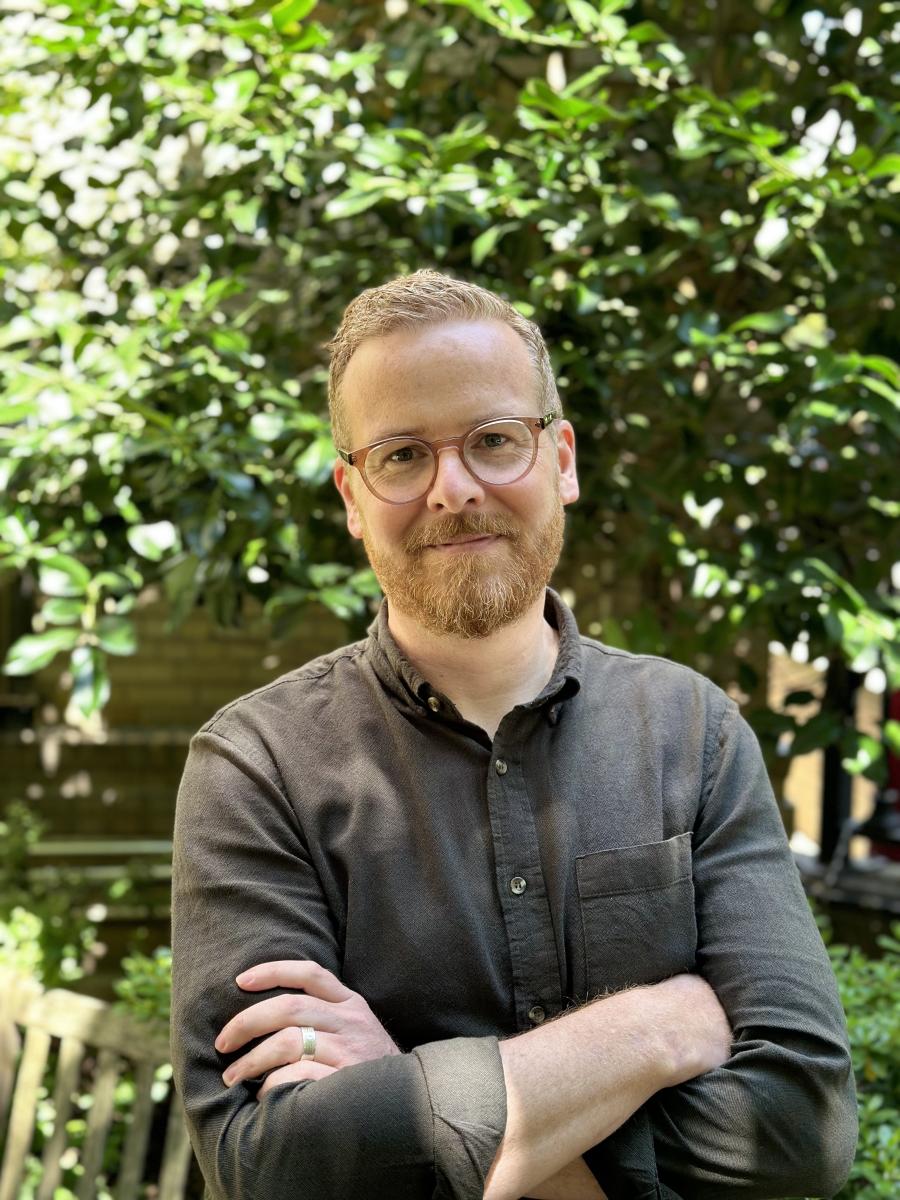
Ashley Moyse, Ph.D.
- Associate Professor of Bioethics
Education
- University of Newcastle, PhD
- Trinity Western University, MTS
- Loyola University Chicago, CAS
- University of Northern Colorado, MSc
- Messiah University, BA
Biography
Ashley John Moyse is a Canadian theologian and ethicist whose work, among other interests, examines moral formation in clinical practice, the cultural and technological forces shaping healthcare, and the lived experience of aging, dying, and suffering. Drawing on theological anthropology, phenomenology, and medical humanities, in addition to his expertise in theology and ethics, his scholarship interrogates the moral possibilities of medicine amid late-modern crises of meaning and institutional trust. He is the author of three books and co-editor of more than ten. His scholarly writing can be found in New Blackfriars, Synapsis, Religions, Chrisian Bioethics, Theoretical Medicine and Bioethics, Journal of Population Ageing, American Journal of Bioethics, American Journal of Medicine, and Medicine Health Care and Philosophy. Opinions and advice columns can be found at Sojourners and Broadview magazines. Prior to joining Baylor, Dr. Moyse held academic appointments at Columbia University Vagelos College of Physicians & Surgeons, and the University of Oxford.
Academic Interests
The ethical life, as Dr. Moyse understands it, is not primarily a matter of choice or principle, but of presence—being with and for others, even when the way is hard and the outcome unclear. Trained in theology, physiology, and bioethics, and weathered by years of work among medical students, physicians, and theologians, he has learned to trust that wisdom grows best where suffering is not shunned and where the body’s burdens are neither idolized nor ignored. He teaches bioethics as if it were concerned with the mystery of being and not a codebook for resolving problems. Accordingly, he writes and teaches not to instruct so much as to invite—to slow down, to attend, and to dwell more honestly with the fleshly reality and inherent vulnerability of human being.
Dr. Moyse’s work has turned steadily toward the places where our cultural promises of mastery and technique ring hollow—among the aged, the dying, the overworked, and the forgotten. His books, such as Resourcing Hope for Ageing and Dying in a Broken World and The Art of Living for a Technological Age, gather wisdom from theology, philosophy, and clinical practice to ask what kind of people we must become in order to care well, to live well, and—just as urgently—to die well.
Before coming to Baylor, he held a professorship in medical ethics in the Center for Clinical Medical Ethics at Columbia University’s medical school where he directed the Character Cooperatives, which aimed to help medical students imagine both physicianship and surgical craft as an intellectual and moral vocation. His current research takes up themes of touch, attention, and the moral deformation and reformation of those who practice medicine. Alongside scholarship, he remains a committed teacher and mentor, supervising projects on everything from moral injury and hope, to dying and digitality, to the ethics of care in a post-Christian age.
At Baylor, you’ll find him guiding students through questions they didn’t know to ask: about bodies and burdens, about what it means to be a becoming human being in light of the human being (Christ), and about how healing happens—or doesn’t—in contemporary healthcare environments. Whether you are an undergraduate seeking a more nuanced understanding of issues arising from our living and dying in and out of Corporate American medicine, or a doctoral student eager to explore where and how theological ethics might aid not only the critical interrogation of but also the constructive responses for our present concerns and crises, Dr. Moyse’s work welcomes you into an old and ongoing conversation: that our life together, in its sorrow and hope, is worth thinking carefully—and caringly—about.
More at: ajmoyse.com
Research and Supervisory Interests
In addition to the above biography that sketches my interests, the following are areas of sustained interest:
- Theological and philosophical ethics, with interest in bioethics/ medical ethics concerns including (a) the posture of inattention/distraction in the digital age of clinical medicine and the rediscovery of purpose through touch and tact, (b) the intellectual and moral formation/malformation of healthcare workers, (c) voluntary dying (ranging from suicide to medical assistance in dying), (d) medicalization of aging, and (e) forced admission to psychiatry, capacity assessments, and treatment over objection (issues where communication/communality is fractured by clinical routines and competing priorities).
- Critical philosophy and theology/ Cultural theory of technology
- Phenomenology, with interest in experiences of frailty, burden, dependence, and finitude
Publications
Books:
Resourcing Hope for Ageing and Dying in a Broken World: Wayfaring Through Despair. Afterword by Lydia S Dugdale. Anthem Religion and Society Series, edited by Yuri Contreras Vejar and Bryan S Turner. London: Anthem, 2022 (Paperback, 2024)
The Art of Living for a Technological Age: Toward a Humanizing Performance. Afterword by Brent P Waters. Dispatches Series, edited by Ashley John Moyse and Scott A Kirkland. Minneapolis: Fortress, 2021
Reading Karl Barth, Interrupting Moral Technique, Transforming Biomedical Ethics. Content and Context in Theological Ethics Series, edited by Mary Jo Iozzio. New York: Palgrave MacMillan, 2015
Co-edited Books:
Before Theological Study: A Thoughtful, Engaged, and Generous Approach. Special introduction by Joas Adiprasetya. Afterword by Janet Soskice. Eugene: Wipf & Stock, 2021
Treating the Body in Medicine and Religion: Jewish, Christian, and Islamic Perspectives. Foreword by Jeffrey P. Bishop; Special introduction by H Tristram Engelhardt, Jr. Routledge Studies in Religion Series (Abingdon and New York: Routledge, 2019 (Paperback, 2021)
Kenotic Ecclesiology: Select Writings of Donald M. MacKinnon. Foreword by Rowan Williams. Minneapolis: Fortress, 2016
Correlating Sobornost: Conversations Between Karl Barth and the Russian Orthodox Tradition. Foreword by Rowan Williams. Afterword by Kallistos Ware. Minneapolis: Fortress, 2016
Dispatches: Turning Points in Theology and Global Crises. A curated book series published by Fortress Press from 2017 to 2022:
- Joerg Rieger, Theology in the Capitalocene: Ecology, Identity, Class, and Solidarity
- Anna Mercedes, Interrupting a Gendered, Violent Church
- Ashley Moyse. The Art of Living for a Technological Age
- Marcus Pound, Theology, Comedy, Politics
- John C McDowell, Theology & the Globalized Present: Feasting in the Future of God
- Cyril Hovorun, Political Orthodoxy: The Unorthodoxies of the Church Coerced
- John W de Gruchy, The End Is Not Yet: Standing Firm in Apocalyptic Times
Articles
with Benjamin Frush and John Brewer Eberly, Jr.. ‘“MAiD Specialists?” Specialization as a Feature of Bureaucracy, not Medicine, in Canada’, American Journal of Bioethics 25, no. 5 (2025): 53-56. Open peer commentary
with Jordan Mason. ‘The Soul (Put to Work) in Medicine: A Response to Arthur Kleinman’, The New Blackfriars 106, no. 2 (2025): 143-155.
with Jonathan M Cahill and Lydia S Dugdale. ‘Ruptured selves: moral injury and wounded identity’, Medicine, Health Care and Philosophy 26 (2023): 1-7
‘Janet Malek’s programmatic secularism? A dissent’, Christian Bioethics 28, no. 2 (2022): 99-108.
’Bearing the burdens we (don’t tend to) bare: Independence as “one more opportunity for me to fail”’, Journal of Population Ageing 14, no. 3 (September 2021): 387-409
’Fodder for despair, masquerading as hope: Diagnosing the postures of hope(lessness) at the end of life’, Religions 10, no. 12 (2019): 651-669.
Courses Taught at Baylor:
REL 3300 Christian Ethics
REL 4395 Bioethics
REL 5362 Christian Anthropology
- Contact Information
- Ashley_Moyse@baylor.edu
- Office Location
TBB GL02.24
- Ashley's Curriculum Vitae
- Curriculum Vitae